
How Custom Golf Shafts Enhance Distance and Accuracy
Written by Patrick Greene|Golf shaft specialist with 15+ years in

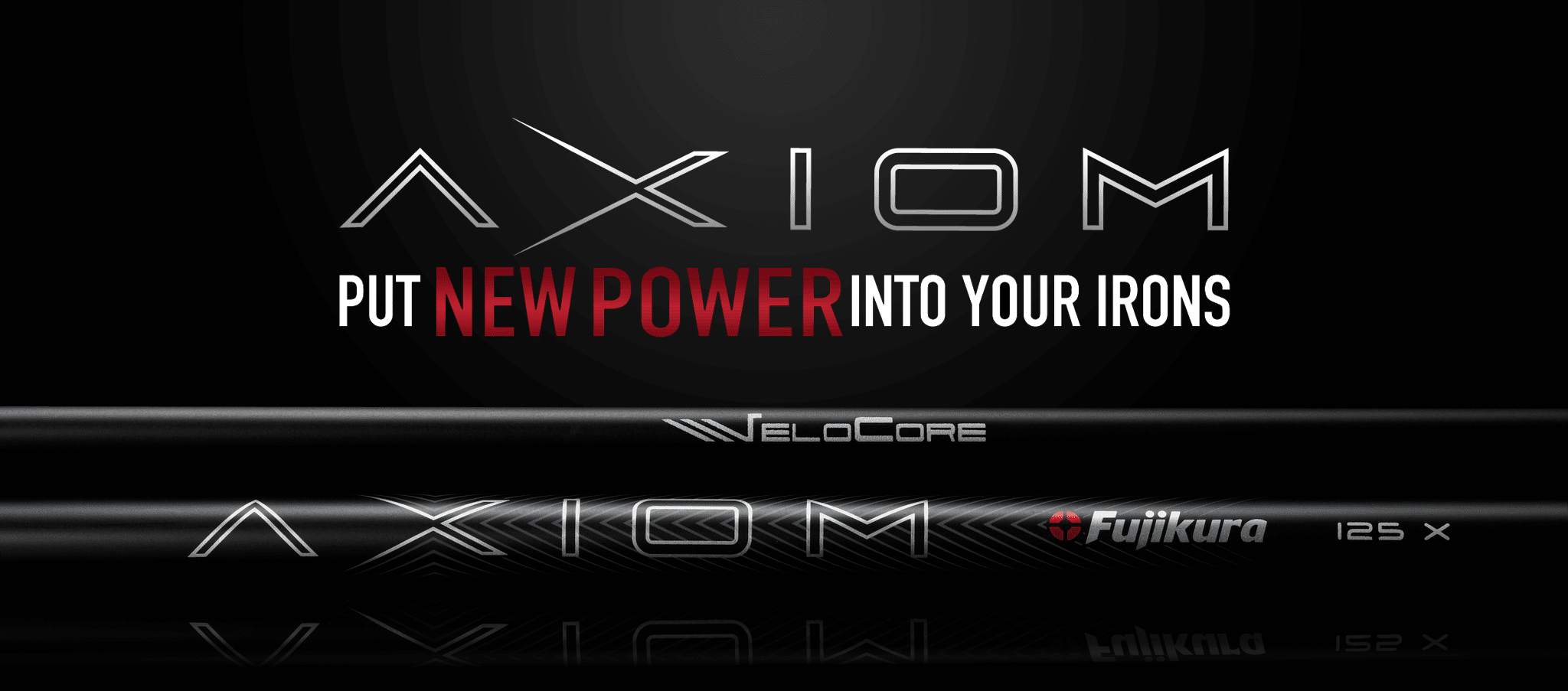
The Axiom 105 and Axiom 125 share Fujikura’s VeloCore construction and three-part iron-shaft design, but they are not interchangeable options. The 20-gram weight difference changes the total club build, how much mass a golfer feels during the swing, and which players are most likely to test each model successfully.
This comparison explains the differences without assigning a shaft by handicap or driver swing speed alone. Both models are premium graphite iron shafts, and the right choice depends on delivery, tempo, strength, preferred total weight, iron heads, and launch-monitor results.
Fujikura’s current Axiom specifications should be the source of truth for exact weights, torque, available configurations, and build guidance. Specifications can vary by flex and by long-, mid-, or short-parallel section.
Axiom is a composite iron-shaft family built around Fujikura’s VeloCore Technology. The manufacturer describes VeloCore as a multi-material bias core intended to support stability during transition and through impact. The same technology platform is used across the Axiom weight options, so choosing between 105 and 125 is not a choice between “basic” and “premium.” It is a fit decision within the same family.
Both models also use Axiom’s three-part design:
This matters when ordering a set. The builder needs the correct sections and must follow the current trimming instructions rather than treating every raw shaft as identical.

Fujikura positions the Axiom 105 as a mid-weight option for players across a range of swing speeds. It is available in S and X flexes and offers a lighter package than many traditional heavy steel builds.
In the current parallel specifications, the long-parallel 105 S and X models are listed at 105 grams with 1.9 degrees of torque. Torque decreases through the mid- and short-parallel sections. The bend-point, launch, and spin designations also differ slightly between S and X, which is one reason flex should not be selected from weight alone.
The 105 is a logical test candidate for a golfer who:
Those are testing clues, not prescriptions. A smooth player can prefer a heavier shaft, and an aggressive player can perform well with a lighter one when the full build supports their delivery.
The Axiom 125 is the heavier option. Fujikura describes it for players with the strength and speed to support an aggressive delivery. Its published specifications show a higher bend point and lower-spin designation than the 105, while both weight classes are listed in the same mid/low launch category.
In the current parallel specifications, the long-parallel 125 S is listed at 125 grams and 1.6 degrees of torque. The 125 X long-parallel option is listed at 125 grams and 1.5 degrees. Torque decreases farther through the set.
The 125 is a logical test candidate for a golfer who:
The 125 is not automatically more accurate, and the 105 is not automatically easier to hit. Accuracy comes from the combination that helps the golfer deliver the club predictably.

Twenty grams per shaft is large enough to affect the feel of an entire iron set. It can change how quickly the club starts down, how clearly the golfer senses the shaft and head, and how fatigue appears late in a session or round.
A lighter build may help one player maintain tempo and centre contact. The same reduction may make another player rush the transition or lose awareness of the club. A heavier build may help one player sequence the swing, while another begins compensating or struggling to finish the motion.
The useful question is not “Which shaft is faster?” It is “Which complete club produces the most repeatable delivery without requiring extra effort?”
Shaft weight is only one part of total club weight and balance. Head model, head weight, playing length, grip weight, build-up tape, tip configuration, and swingweight all affect the result.
When comparing Axiom 105 and 125:
A poorly matched test build can make the right shaft look wrong. Ask the fitter or builder to explain any differences beyond the shaft itself.
Carry distance alone is a weak way to choose an iron shaft. The fitter should evaluate the golfer’s typical strike pattern and how the full set would need to perform.
Useful comparison points include:
The final choice may differ between a short indoor fitting and a full-set build. A good fitter can discuss how the selected shaft progresses from long irons to scoring clubs.
Driver speed can help describe the golfer, but it does not capture iron tempo, transition, release, desired flight, or preferred total weight. Two players with similar speed can load an iron shaft differently and choose different Axiom weights.
Handicap is even less useful as a shaft prescription. A lower-handicap golfer may prefer the 105, while a mid-handicap golfer with a familiar heavy-steel build may test better in the 125. Use labels as starting points and measured performance as the decision.
Start by documenting the current steel build: shaft model, approximate weight, playing length, grip, total weight, and ball-flight pattern. That gives the fitter a baseline.
A golfer leaving a 120- to 130-gram steel shaft may find the Axiom 125 familiar in mass while noticing a different feel from composite construction. A golfer who wants a meaningful but not extreme reduction may prefer testing the Axiom 105 first. Neither transition should be judged from waggle feel alone.
Hit enough shots to understand strike, dispersion, and effort. If joint comfort is part of the reason for considering graphite, discuss that goal with both the fitter and an appropriate health professional rather than assuming one weight will solve a physical problem.
Before ordering an Axiom set, confirm:
Fujikura notes that the parallel Axiom shafts use a .370 tip and can be trimmed for certain .355 taper-tip hosels when its instructions are followed. Taper-tip versions are individually prepared for the corresponding iron. This is specialized club-building work; verify the head and follow the manufacturer’s current instructions.
No. It is a heavier, lower-torque option intended for players who can support that mass and delivery profile, but playing level alone does not decide fit. A golfer should test it in a representative iron build.
Not automatically. A lighter shaft can help some golfers move the club more comfortably, but others lose timing or strike quality. Compare measured ball flight and dispersion rather than assuming a speed gain.
Fujikura currently lists the Axiom 105 and 125 in S and X flexes. Exact weights and torque values vary by model and shaft section, so review the current specification table before ordering.
That would be a specialized fitting and build decision. It can change total weight progression and feel between clubs. Do not mix sections or weights without a documented plan from a qualified fitter or builder.
The Axiom 105 offers a mid-weight route into Fujikura’s VeloCore iron platform. The Axiom 125 keeps substantially more mass and lower torque for players who perform better with a heavier, more stable-feeling build.
Use the published specifications to narrow the test, then let strike, dispersion, launch, carry consistency, and effort determine the winner. You can review the available Fujikura Axiom iron shaft options at Bogey Buster and confirm the exact set configuration before ordering.
Also Read: Utility Iron Shafts: Fitting the Club Between Your Irons and Hybrids
Written by Patrick Greene|Golf shaft specialist with 15+ years in

Written by Patrick Greene|Golf shaft specialist with 15+ years in

Free golf guide · 26 pages
How to Teach Your Wife Golf (And Live to Talk About It)
A funny, practical guide to better golf and fewer arguments: setup, swing, short game, putting and what not to say on the course.
Get the free guide